Accessibility Audit — European Breakdown Cover Sales Funnel
Audited and prioritised accessibility issues in a customer-critical, seasonally sensitive sales funnel used by UK customers purchasing European Breakdown Cover, translating WCAG 2.1 requirements into prioritised, implementation-ready remediation guidance to reduce risk and improve inclusive access.
Summary
Problem
UK customers purchasing European Breakdown Cover encountered accessibility barriers in a seasonally sensitive sales funnel, limiting inclusive access and exposing the business to compliance, reputational, and abandonment risk.
Solution
Led a comprehensive accessibility audit combining automated testing and manual evaluation, documenting issues against WCAG 2.1 and translating findings into a prioritised, implementation-ready remediation plan.
Impact
Improved the experience for keyboard, screen reader, and low-vision users across the entire purchase journey, reduced legal and usability risk ahead of peak travel periods, and enabled teams to address high-severity issues efficiently while strengthening accessibility awareness.
Business Context
-
Why this mattered:
- The European Breakdown Cover funnel supports UK customers purchasing cover ahead of time-sensitive travel to Europe. Accessibility failures risked excluding customers, increasing abandonment, and exposing the business to compliance and reputational risk during peak travel periods.
-
Constraints:
- Legacy codebase
- Limited developer availability
- No scope for visual redesign
-
Success metrics:
- WCAG 2.1 A / AA compliance improvements
- Reduction in high-severity accessibility failures
- Faster remediation through clear prioritisation and guidance
The Core Problem
Multiple accessibility barriers existed across the funnel, disproportionately affecting keyboard and screen reader users and increasing the risk of failed purchases.The challenge was not only identifying issues, but making them actionable and prioritised within real delivery constraints.
Strategy & Approach
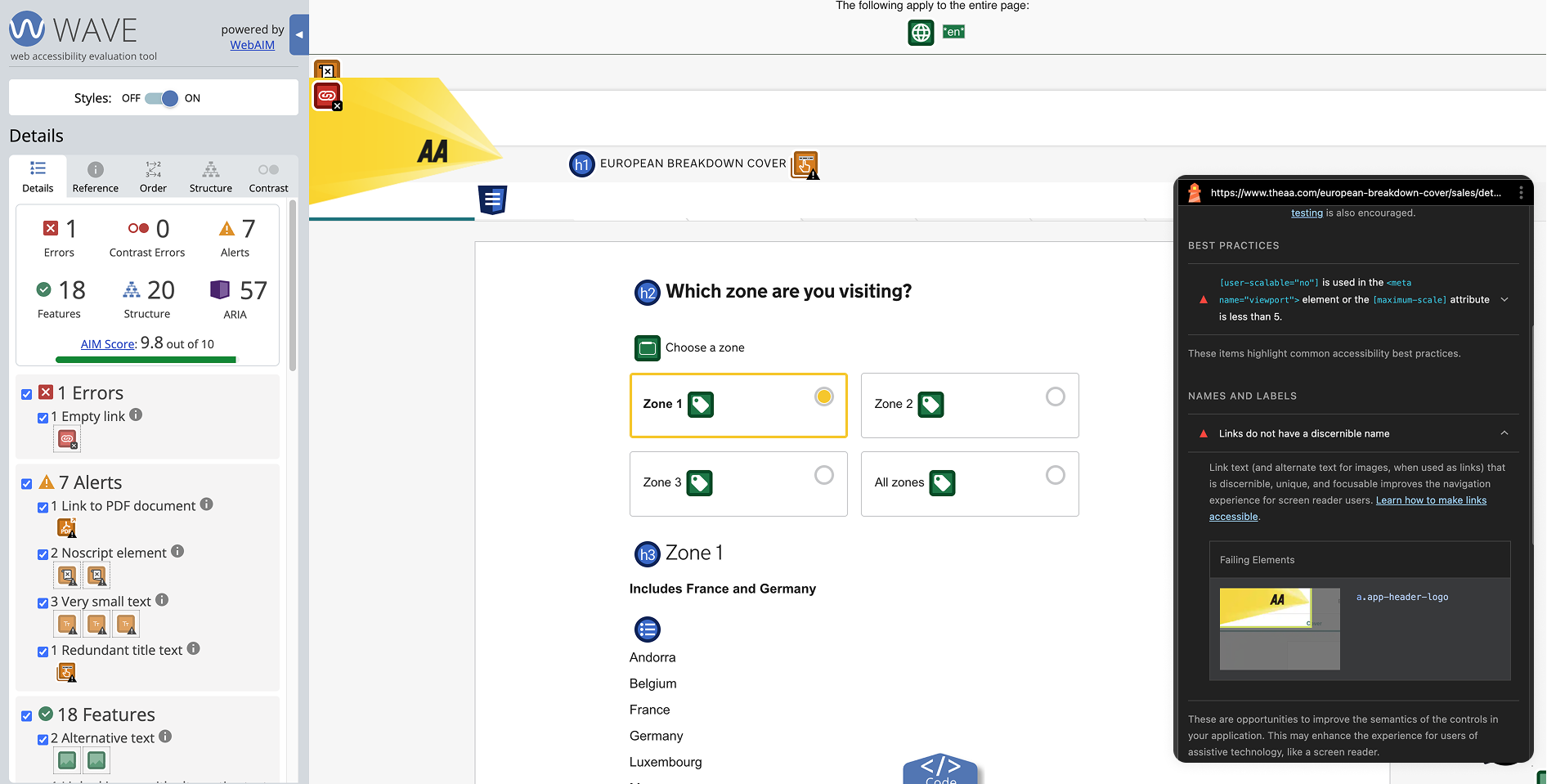
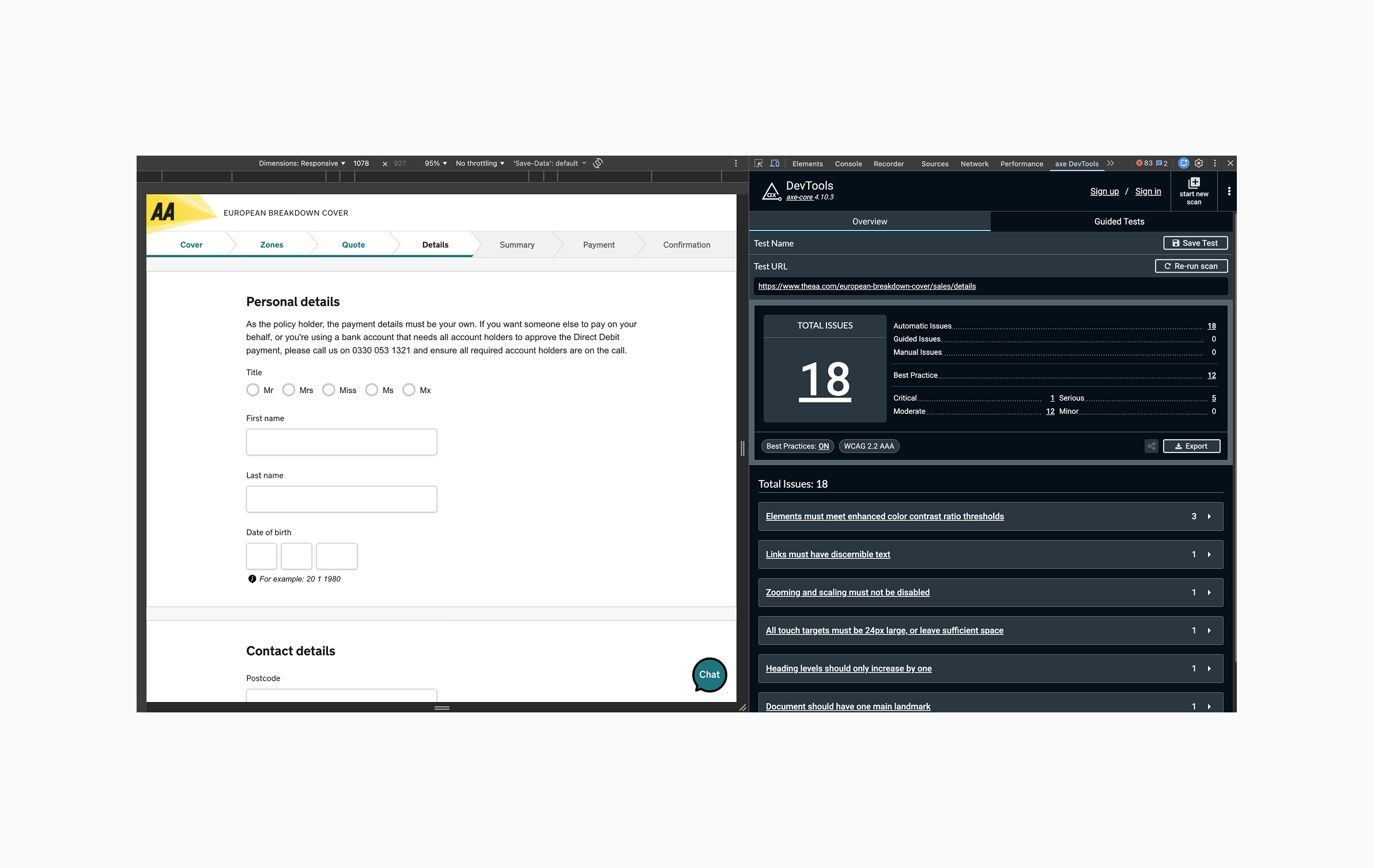
- Conducted automated tests (Axe, Lighthouse, WAVE) and manual checks (Keyboard navigation, VoiceOver, JAWS, Screen settings: Font, Scale, CSS-OFF).
- Categorised issues by levels of severity and impact.
- Created a remediation plan with suggested fixes (including front-end snippets where needed).
- Mapped issues to user impact and funnel stages to support prioritisation.
- Presented findings to the team and aligned on priorities.
- Tracked implementation progress and re-tested to validate fixes.
Key Design Decisions
Maximising impact within a short window of development availability drove the following decisions:
Decision #1: Prioritise critical WCAG failures
- Rationale: High-severity issues (keyboard traps, semantic problems, unlabeled items) directly impact usability.
- Trade-offs: Non-critical enhancements planned for future sprints.
Decision #2: Provide actionable recommendations for developers
- Rationale: Ensures team can implement fixes quickly without guesswork.
- Support: Included code snippets and example fixes to reduce friction.
Process Snapshots
These snapshots illustrate how accessibility was evaluated and validated throughout the work. Rather than relying on a single tool, I combined automated audits with manual testing to uncover both systematic issues and real interaction failures. This approach helped prioritise fixes, validate WCAG 2.1 A/AA compliance, and ensure changes improved real usability rather than passing checks in isolation.
Impact
This audit enabled teams to focus on the most critical accessibility risks first, improving WCAG 2.1 AA compliance while reducing user friction in a revenue-critical funnel.
Quantitative Results
- 26 accessibility issues identified across the funnel.
- 10 high-severity issues prioritised for remediation.
- ~60% of link clarity and semantics issues resolved within one sprint.
- Keyboard navigation success improved from ~50% to ~75%.
- Overall accessibility errors reduced from 26 → 14.
Note: Several remaining issues required deeper platform or third-party changes and were documented for follow-up remediation.
Qualitative Outcomes
- Improved confidence for keyboard and screen reader users.
- Reduced risk ahead of peak seasonal traffic.
- Increased accessibility awareness across design and engineering.
- Established a repeatable audit and prioritisation model.
Learnings & Leadership
Learnings
- Accessibility is often overlooked; regular audits are essential to prevent regression.
- The combination of automated and manual testing is crucial.
- Small, actionable guidance beats long and generic reports.
Leadership
- Mentored team on accessibility best practices.
- Advocated for accessibility as a design priority, not a compliance checkbox.
- Established process for ongoing accessibility testing.